Ancient Colombia: The Land Before Colombia
Introduction
Before it was called Colombia, this land already held thousands of years of memory.
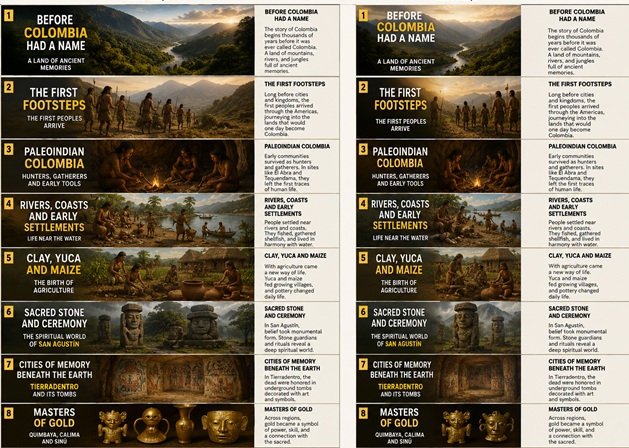
Long before cities and kingdoms, the first peoples arrived through the Americas, moving step by step into the lands that would one day become Colombia. They came not as conquerors, but as travelers — following rivers, coastlines, and the great mountain ranges that would eventually shape the nations of South America.
Their story is not a prelude to conquest. It is a history in its own right — a history of adaptation, invention, and spiritual depth that deserves to be told on its own terms.
1. Colombia Before Colombia
The territory we now call Colombia has been inhabited for at least 12,400 years. Long before the Spanish arrived, long before the Muisca or the Tairona, human beings were already walking these lands.
Archaeology is our time machine. Every stone tool, every bone fragment, every trace of charcoal from an ancient hearth is a page in a book written not in ink, but in earth. And in Colombia, that book is extraordinarily rich.
This is not the story of a single people or a single civilization. It is the story of hundreds of Indigenous nations, each with its own language, traditions, and relationship with the land.
2. The First Footsteps — Migration and Early Peoples
The first peoples arrived in the Americas during the last Ice Age, crossing from Siberia into Alaska across a land bridge that once connected the two continents. Over thousands of years, their descendants moved south into South America.
In Colombia, the earliest evidence of human presence comes from El Abra and Tequendama, near Bogotá. These were hunting camps — places where Paleoindian peoples stopped to butcher game, make tools, and rest.
At El Abra, archaeologists have found stone tools dating back more than 12,400 years. At Tequendama, similar traces date to approximately 12,500 years ago . These are the first footprints of human life in Colombia.
3. From Nomads to Settlements — Archaic Life
As the climate warmed and the great Ice Age megafauna disappeared, human communities began to adapt. People gathered near rivers and coasts, where food was abundant and predictable.
Along the Caribbean coast, communities formed shell middens — large piles of discarded shells that still mark the sites of ancient settlements. Tools became more specialized. Fishing nets and hooks appeared. And in some places, people began to make the first crude ceramics.
4. Clay, Yuca, and Maize — The Formative Period
With agriculture came a new way of life. Settled villages emerged, along with pottery and the beginnings of social complexity.
Puerto Hormiga, near the Caribbean coast, is one of the oldest ceramic sites in the Americas, dating to approximately 3000–2500 BCE. Here, archaeologists have found the earliest evidence of pottery in Colombia — fragments of vessels that once held food, water, and offerings.
Malambo, near Barranquilla, was another early ceramic site. Its people made vessels with incised geometric patterns and stamped designs, showing that pottery was not just practical — it was also expressive.
Clay became a canvas for memory, belief, and identity. The first potters of Colombia were not simply making tools — they were creating tradition.
---5. Sacred Stone and Ceremony — Tumaco, San Agustín, Tierradentro
Tumaco
On the Pacific coast, the Tumaco culture (approximately 300 BCE–600 CE) produced some of the finest goldwork and ceramics in ancient Colombia. Their artisans crafted intricate figurines, masks, and jewelry, often depicting animals, plants, and human forms.
San Agustín
In the mountains of present-day Huila, the ancient sculptors of San Agustín carved belief into stone. Their monumental statues — depicting guardians, deities, and ancestral figures — stand watch over sacred spaces for over a thousand years.
Carved in volcanic rock, these sculptures blend human and animal forms — jaguars, eagles, and serpents — expressing a worldview where the natural and the supernatural were deeply intertwined.
San Agustín was designated a UNESCO World Heritage Site in 1995, recognized as “the largest group of religious monuments and megalithic sculptures in South America”.
Tierradentro
In the mountains of present-day Cauca, the ancient people of Tierradentro honored their dead in extraordinary underground tombs. These chambers — carved into volcanic rock — were painted with geometric patterns in red, white, and black.
They were not merely graves; they were cities of memory, places where the living maintained connection with their ancestors.
Tierradentro was designated a UNESCO World Heritage Site in 1995, recognized as “the largest concentration of hypogea (underground tombs) in the Americas”.
6. Gold and Power — Quimbaya, Calima, Sinú
Across regions like Quimbaya, Calima, and Sinú, gold became more than decoration. It reflected power, skill, and a deep connection between the human and sacred worlds.
The Quimbaya flourished in the Cauca River valley, famous for the Poporo Quimbaya — a vessel representing a fertility ritual, now housed in the Museo del Oro in Bogotá. For the Quimbaya, gold represented the sun — a source of life, power, and spiritual energy.
The Calima flourished in the Calima River valley, known for gold pectorals, masks, and elaborate nose rings. Their artisans used tumbaga — an alloy of gold and copper — to create objects of extraordinary detail.
The Sinú (also known as Zenú) flourished in the Sinú River valley, mastering filigree and intricate casting. Their ceramics were equally remarkable — often depicting maternal figures, animals, and geometric patterns.
For these cultures, gold was not currency — it was a sacred language of power and belief.
---7. The Sierra Builders — Tairona and Ciudad Perdida
In the Sierra Nevada de Santa Marta, the Tairona built complex settlements of stone, linked by terraces and paths. Their world rose from the mountain with intelligence and balance.
The Tairona flourished from approximately 200 CE to 1600 CE . They built stone cities — Ciudad Perdida (Lost City, also known as Teyuna) is the most famous — with terraced platforms, stone stairways, drainage systems, and ceremonial plazas.
Archaeologists believe the Tairona built Teyuna in the ninth century, about 650 years before Machu Picchu [citation:5]. At its height, Teyuna is thought to have housed between 2,000 and 8,000 inhabitants.
When the Spanish arrived, the Tairona resisted for decades. Many fled into the mountains, where their descendants — the Kogui, Arhuaco, Wiwa, and Kankuamo — still live today, preserving the traditions of their ancestors.
8. The Muisca World — Zipa, Zaque, Agriculture, Houses, Social Structure
On the high plains of present-day Cundinamarca and Boyacá, the Muisca developed one of the most organized societies in the region. They cultivated maize, potatoes, and quinoa on terraced hillsides. They wove cotton textiles, traded salt, emeralds, and gold, and built a political system divided into two powerful federations.
Their leaders were called zipas in the south and zaques in the north. They governed through alliances, tribute, and ritual. They understood astronomy, crafted gold with extraordinary skill, and created a complex calendar that governed planting, harvesting, and ceremony.
Recent scholarship describes Muisca society as modular-cellular rather than a rigid pyramid . The basic unit was small capitanías (local groups) governed by a capitán — often the maternal uncle. These groups could join into larger confederations, but the bonds were flexible.
Their houses were circular, built of wood and thatch, and grouped into villages around ceremonial centers. Their world was one of order, knowledge, and connection to the sacred.
9. El Dorado and Memory — Guatavita, Gold Offerings, Sacred Symbols
From Muisca ritual was born one of history’s greatest legends: El Dorado, not as a city of gold, but as a sacred offering to the divine.
When a new ruler was appointed, the Muisca people gathered at Lake Guatavita in present-day Cundinamarca. The heir — covered in gold dust from head to toe — stood on a raft as offerings of gold and emeralds were cast into the sacred waters .
This was not greed — it was devotion, a gift to the gods who sustained their world.
When Spanish conquistadors arrived in the sixteenth century, they transformed this spiritual ceremony into a feverish hunt for gold. They drained the lake, searched the mountains, and tortured Indigenous leaders — all chasing a city that never existed.
The legend of El Dorado became the engine of conquest, driving Europeans across the continent, destroying countless Indigenous societies in its wake.
---10. Languages That Remain — Living Memory
The story of Colombia did not begin with conquest. It began with peoples, languages, memory, and civilizations whose legacy still lives in the land.
Today, Indigenous communities across Colombia carry forward ancient traditions:
- The Muisca in Cundinamarca and Boyacá
- The Zenú in Córdoba and Sucre
- The Kogui and Arhuaco in the Sierra Nevada de Santa Marta
- The Wayúu in La Guajira
- The Nasa in Cauca
- The Emberá in Chocó
- The Tikuna, Uitoto, and Bora in the Amazon
Their languages — Chibcha, Caribe, Arawak, Quechua, and many more — are not relics of the past. They are living expressions of a history that predates colonization by thousands of years.
The gold, the pottery, the stone, the sacred landscapes — these are not just artifacts. They are voices from a deep past that still speak.
Conclusion: A New Series Begins
This article is the first in our new series, Hispanic Era. It marks the beginning of a journey through Colombia’s deep history — from the first footsteps to the present day.
We begin here, before the Republic, before the conquest, before the names. We begin with the land and its first peoples, because their story is the foundation of everything that followed.
Colombia’s identity is not defined solely by colonial history, but by the civilizations that flourished long before — whose descendants remain, whose stories endure, whose presence continues to shape the soul of this land.