Colombia Presidential Elections Consulados 2026
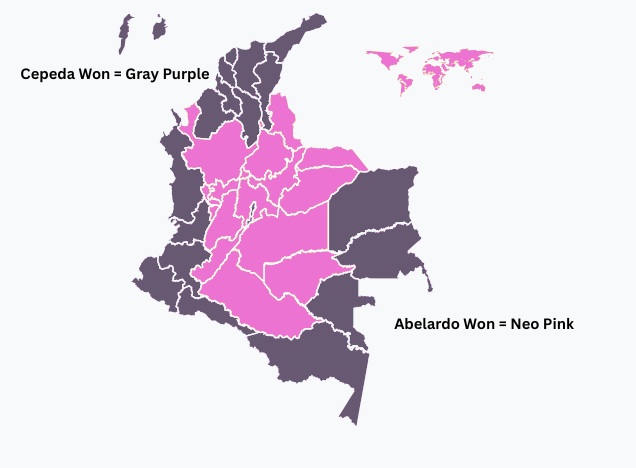
In Colombia, Cepeda’s base has the lowest turnout. Overseas, it’s the opposite. What changed?
At home, Cepeda’s voters are the hardest to reach — scattered across Chocó, Guainía, and Vaupés, where turnout hovers around 33%. His domestic base is the sleeping giant. Overseas, the pattern inverts completely
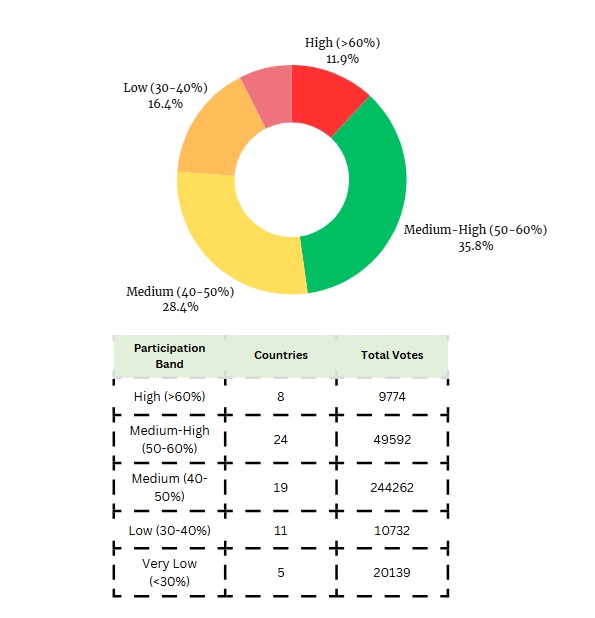
PARTICIPATION BANDS — WHO WINS WHERE:
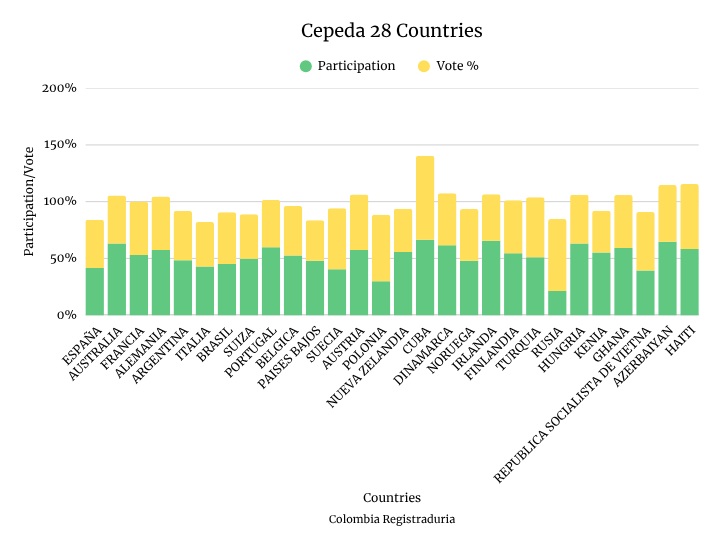
THE HIGH-TURNOUT COUNTRIES (Cepeda’s Overseas Strongholds):
6 of the 8 highest-turnout countries went to Cepeda. These are mostly European — probably places where Colombian diaspora communities are educated, organized, and mobilized. Other factores
1. Geography Is the Enemy
A Colombian in Dublin is never more than a few hours from the consulate. A Colombian in Houston might be a 3-hour flight from the nearest consulate that handles voting. It’s not ignorance. It’s distance.
2. Work and Fear
Many Colombians in the US work hourly jobs, missing a shift to vote means losing income. Some are undocumented or have mixed-status families, walking into a government building (even a Colombian consulate) can feel risky. It’s not apathy. It’s survival.
3. Information Barriers
European Colombian communities tend to be smaller and tighter — word spreads fast. In the US, Colombians are spread across 50 states, integrated into massive Latino communities. Reaching them is harder. It’s not education. It’s fragmentation.
4. The Real Comparison
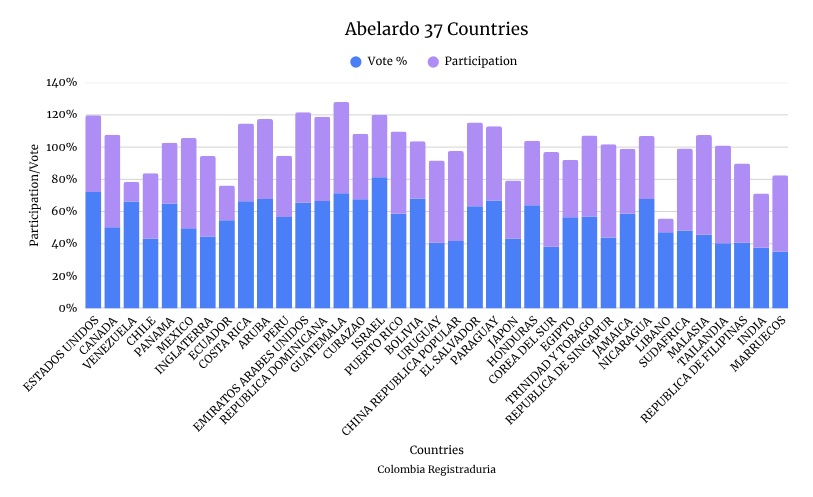
The US had the largest Colombian diaspora turnout in absolute numbers: 102,788 voters. That’s more than the entire eligible populations of most countries. But as a percentage, it looks modest — 47.57% — because the US has 216,000 eligible Colombians scattered across 9.8 million square kilometers with only a handful of consulates. Voting shouldn’t require a plane ticket.
For USA elegible voters 216,105 as a result a turnout 47.57% because 102,788 voters who showed up
For Cuba elegibel voters 677 as a result a turnout 66.37% because 449 voters who showed up
For Ireland elegible voters 377 as a result a turnout 65.47% because 247 voters who showed up
THE VERY LOW-TURNOUT COUNTRIES (Abelardo’s Ghost Towns):
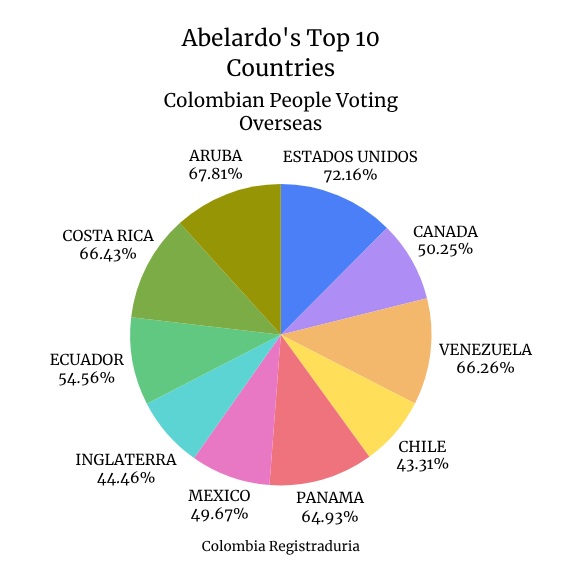
Venezuela is the shocker here. 21,751 registered voters. Third-largest diaspora. Abelardo won it with 66%. But only 12% voted — the lowest of any major country. 87% of eligible Colombians in Venezuela didn’t vote. That’s 19,000 potential votes — sitting on the table.
WHY THE PATTERN FLIPPED:
At Home Abroad Cepeda’s base = rural, remote, poor infrastructure Cepeda’s diaspora = European, urban, educated
Low turnout = structural barriers (no roads) High turnout = easy access (embassies in capital cities)
Abelardo’s base = connected Andean cities Abelardo’s diaspora = Americas, many in crisis zones
The barriers are different. At home, it’s geography. Abroad, it’s bureaucracy, distance to consulates, and — in Venezuela’s case — a country in collapse.
THE KEY INSIGHT:
Candidate Domestic Turnout Pattern Overseas Turnout Pattern
Cepeda Wins LOW-turnout regions Wins HIGH-turnout countries
Abelardo Wins HIGH-turnout regions Wins LOW-turnout countries
Both candidates face the same paradox, just in reverse: Cepeda’s overseas voters show up (but there aren’t enough of them). Abelardo’s overseas voters are numerous (but they don’t show up).
THE SLEEPING GIANTS — OVERSEAS EDITION:
Candidate Sleeping Giant Eligible Voters Turnout Potential New Votes
Abelardo 🇻🇪 Venezuela 21,751 12.03% ~19,000
Abelardo 🇺🇸 USA 216,105 47.57% ~113,000
Cepeda 🇪🇸 Spain 127,637 41.44% ~75,000
Abelardo’s overseas sleeping giant is bigger. But both candidates have room to grow.
WHAT THIS MEANS FOR THE RUNOFF:
The overseas vote is NOT locked in. Only 41.69% of eligible Colombians abroad voted. That leaves 825,000 potential voters.
Cepeda’s high-turnout advantage is real but small. His 6 high-turnout countries total 9,774 votes. A rounding error.
Abelardo’s low-turnout disadvantage is also his opportunity. If Venezuelan turnout rises from 12% to even 30%, he gains thousands of votes.
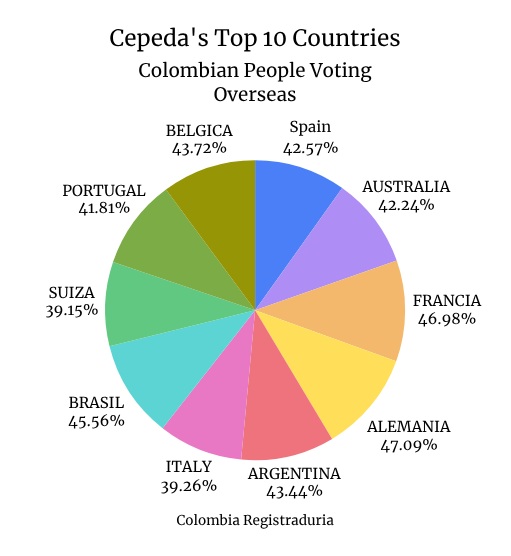
The real overseas battleground is Spain. 127,637 voters. Cepeda won it narrowly (42.57%). Turnout was 41%. This is the one country that could swing the overseas result.
Conclusion
Cepeda’s 28 countries — European base, small pluralities
Abelardo’s 37 countries — Americas wall, USA the giant
The participation reversal — abroad, Cepeda wins where turnout is high
Data: Registraduría Nacional del Estado Civil, June 02, 2026. Análisis, visualizations by pacificsnewbies.*
📈 Video about this Post
Frequently Asked Questions
What are Consulados in Colombian elections?
Consulados are the voting stations at Colombian embassies and consulates around the world. Colombians living abroad can vote in presidential elections at these locations. In 2026, over 1.4 million Colombians were eligible to vote overseas across 65 countries.
Who won the overseas vote in Colombia’s 2026 election?
Abelardo de la Espriella (Centro Democrático) won the Consulados with 54.36% of the vote — 319,988 votes. Iván Cepeda Castro (Pacto Histórico) received 28.46% with 167,526 votes. The remaining votes went to other candidates.
Which country had the most Colombian voters abroad?
The United States had the largest Colombian diaspora with 216,105 eligible voters. Spain was second with 127,637 voters. Together, these two countries represented nearly 60% of all eligible overseas voters.
What was voter turnout in the Consulados?
Overseas turnout was 41.69% — meaning about 589,000 of the 1.4 million eligible Colombians abroad actually voted. This is lower than the national turnout of 57.88%. Distance from consulates, time zones, and registration barriers are common reasons for lower overseas participation.
Why did Abelardo win more overseas votes than Cepeda?
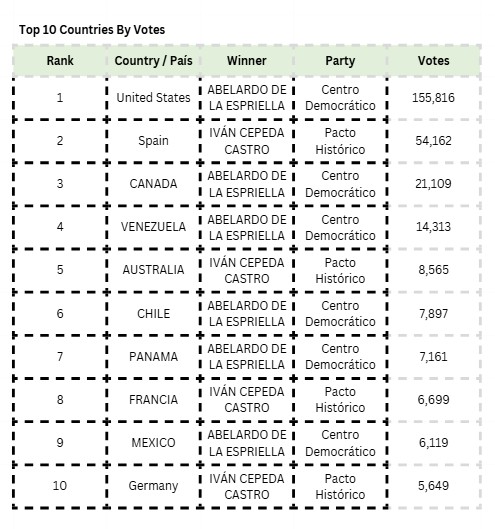
Abelardo dominated the Americas — winning the United States, Canada, Venezuela, Mexico, and most of Central and South America. The USA alone gave him 155,816 votes at 72.16%. These countries have the largest Colombian diaspora populations. Cepeda won more countries in Europe, but with fewer total voters.
What does ‘winner votes’ mean in the charts?
Winner votes refer to the votes received ONLY by the candidate who won that specific country or department. It does NOT include votes for losing candidates in that territory. This is different from the total popular vote.
What is ‘participation rate’ or ’turnout’?
Participation rate (also called turnout) is the percentage of eligible voters who actually cast a ballot. For example, if 100 people are eligible and 57 vote, the turnout is 57%. It measures civic engagement — how many people showed up.
What does ‘vote share’ or ‘vote %’ mean?
Vote share is the percentage of total valid votes a candidate received. For example, Abelardo’s 54.36% in Consulados means that out of every 100 valid votes cast abroad, about 54 went to him. It does not include blank or null votes.
Which country had the highest overseas turnout?
Cuba had the highest participation rate at 66.37%, though the total number of voters was small (449 votes). Among larger diaspora communities, Australia had the highest turnout at 63.18% with 20,296 eligible voters.
Why was Venezuela’s turnout so low (12%)?
Venezuela has the third-largest Colombian diaspora with 21,751 eligible voters, but only 12.03% voted. Venezuela’s ongoing political and economic crisis has reduced consular services, and many Colombians there face documentation and mobility challenges.
What is a ‘margin’ in elections?
A margin is the difference between the winner and the second-place candidate. For example, in the Consulados, Abelardo won with 54.36% and Cepeda had 28.46% — a margin of 25.9 percentage points. A ‘razor-thin margin’ means the race was very close.
What is a runoff election (balotaje)?
A runoff (segunda vuelta or balotaje in Spanish) happens when no candidate reaches 50%+1 of the votes in the first round. Colombia’s 2026 election went to a runoff because Abelardo (43.74%) did not cross the threshold. The top two candidates compete in a second election.
Does winning more countries mean winning the election?
No. Cepeda won 28 countries abroad and 18 departments in Colombia, but lost the popular vote. In Colombia’s system, only total votes nationwide determine the winner — not the number of territories won. This is different from the US Electoral College system.
Sources
- Registraduría Nacional del Estado Civil — Official Consulados election results, May 31 2026.
- resultados.registraduria.gov.co/ — Raw overseas voting data.
- Data compiled, cleaned, and visualized by pacificsnewbies for the Two Colombias election series.